
Search New Castle Death Records
The New Castle County Death Index covers all deaths that took place in the county and are on file with the Delaware Office of Vital Statistics. New Castle County is the largest county in the state, home to about 570,000 people, and its records reach back more than a century. You can order a certified death certificate at the Newark field office, search older rolls through the Delaware Public Archives, or look at probate files at the Register of Wills in Wilmington. This page walks you through each option and who to call for help.
New Castle County Overview
New Castle County Death Index Overview
The New Castle County Death Index is the master list of deaths filed with the state. Every death in the county must be reported within three days. The funeral director files the death certificate. The doctor or medical examiner signs off on the cause of death. The Office of Vital Statistics then adds the record to the state's index. This rule comes from 16 Del. C. § 3123.
Wilmington kept its own city death records as far back as 1881. The rest of the county relied on church books, family Bibles, and graveyard logs. Statewide death registration did not begin until 1930. So the New Castle County Death Index is really two sets of files stacked together. One set holds modern records at the state office in Newark. The other set holds older rolls at the Delaware Public Archives in Dover. You may need both to trace a full family tree.
Here is the image from the 211 Delaware guide for the Division of Public Health's New Castle County office. It shows the service entry point most families use first. You can view it at delaware211.org.
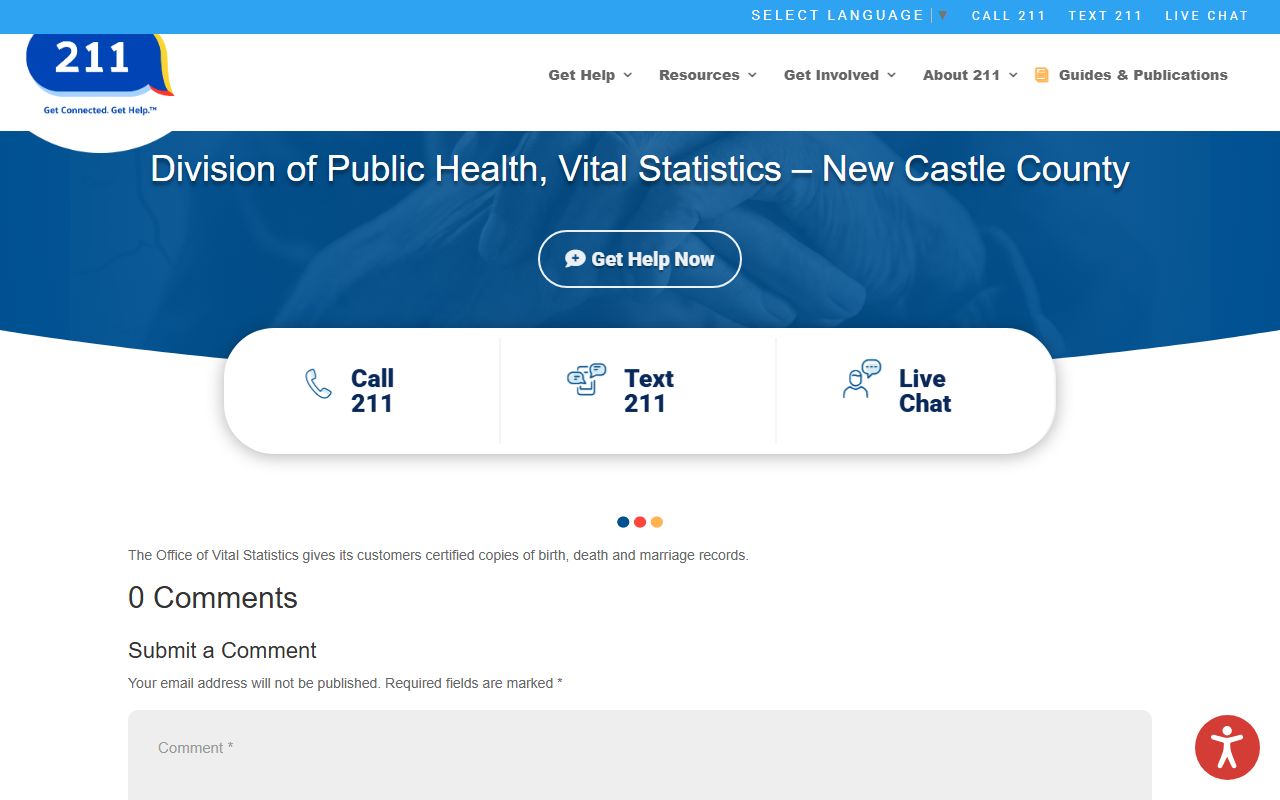
The 211 listing gives the hours, phone, and address for the Newark office. It also notes which forms of ID the staff will accept. This is handy if you plan to walk in during your lunch break. The site is free to use and run by a nonprofit that helps Delaware residents find state services.
Office of Vital Statistics in Newark
The state runs a field office of the Office of Vital Statistics in Newark. This is where most New Castle County families go for a death certificate. The office sits on Chapman Road, just off Route 273, and has free parking. You can walk in, mail a form, or call ahead with questions. The lead state page is at dhss.delaware.gov.
| Office | Division of Public Health — Vital Statistics (New Castle County) |
|---|---|
| Address |
258 Chapman Road Newark, DE 19702 |
| Phone | (302) 283-7130 |
| Fax | (302) 283-7131 |
| Hours | Monday through Friday, 8:00 AM to 4:00 PM |
The Newark office handles death records for all of New Castle County. This includes Wilmington, Newark, Middletown, Bear, Claymont, and the rest of the county. Staff can pull any Delaware death record, not just local ones. That means you can order a record for a relative who died in Sussex or Kent while you are there. The state keeps one master file for the whole state. The county name only changes which walk-in office is closest to you.
Note: The Newark office does not keep full case files. For the paper death certificate only, not the medical examiner's workup or the autopsy, you go to Vital Statistics.
How to Order a New Castle Death Certificate
There are three ways to get a New Castle County death certificate. You can visit the Newark office in person. You can mail in a form with a check. Or you can order online through the state's vendor site. Each path costs $25 per certified copy. The fee comes from state law. For a full fee list and a link to the order form, see the state certificates guide at delaware.gov.
To order a record, you need the full name of the person who died. You also need a date of death or a close year. A city helps too. The clerk will ask for a photo ID. You must state your link to the person, such as spouse, child, parent, or sibling. Under state law, a certified death record is not fully open to the public for the first forty years. That limit is set by 16 Del. C. § 3110(f).
Accepted ways to pay include:
- Cash at the walk-in counter
- Check or money order made out to "State of Delaware"
- Credit card for online and phone orders
- Debit card at the Newark office
The image below comes from the Delaware Office of Vital Statistics page. It shows the main intake portal for death records. Visit the source at dhss.delaware.gov to see the current forms.
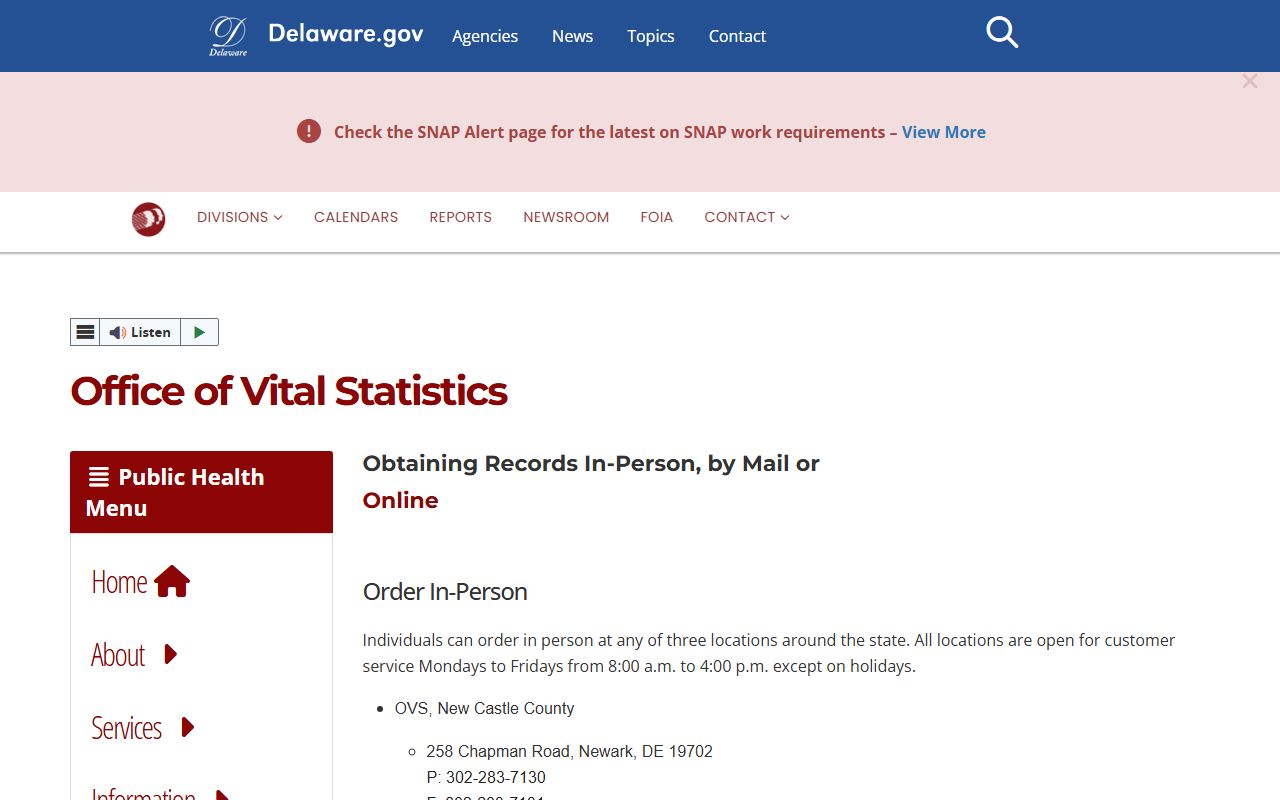
The state site has PDF forms you can print at home. Fill one out, sign it in front of a notary, and send it to the Newark office with your check. Mail orders take about two weeks to come back. Rush orders cost more and ship by overnight courier. The CDC has a summary of Delaware rules at cdc.gov/nchs/w2w that you can use as a backup reference.
New Castle County Death Index Access Rules
Access to the New Castle County Death Index is split by age. For the first forty years after a death, the record is closed. Only family, estate agents, and law firms can get a copy. After forty years, the record turns public. That means anyone can view it and order a copy for family research or news work.
Delaware law on this split lives in Title 16, Chapter 31. You can read the full chapter at delcode.delaware.gov. The rule at 16 Del. C. § 3110 sets the forty-year wait. The Reporters Committee tracks how this works for press use at rcfp.org. You may want to check that guide if you are a reporter or a writer working on a book.
The state's Freedom of Information Act sits under 29 Del. C. § 10002. FOIA in Delaware is only open to state residents. So if you live out of state, you cannot use FOIA to pry open a closed record. You can still order a vital record as next of kin, or wait out the forty years. You can also ask a Delaware resident to file for you.
Some types of people can always get a death record, even one that is less than forty years old:
- Spouse of the person who died
- Parent, child, or grandchild
- Sibling or half-sibling
- Legal guardian or conservator
- Attorney working on the estate
- Life insurance firm with a claim on file
Note: Each request must state the reason and the tie to the deceased; fraud on a vital record request can be charged as a class A misdemeanor.
Probate and Register of Wills in New Castle County
When a person dies in New Castle County and leaves an estate, the case goes to the Register of Wills. This is a county office, not a state one. The office works next to the Court of Chancery. It files wills, keeps the probate docket, and gives out letters for the estate. The office is on the second floor of the Louis L. Redding City/County Building in Wilmington. The building has housed the Register of Wills since 1714.
| Office | New Castle County Register of Wills |
|---|---|
| Address |
Louis L. Redding City/County Building 800 French Street, 2nd Floor Wilmington, DE 19801 |
| Hours | Monday through Friday, 8:30 AM to 5:00 PM |
Under state law, an estate must be probated if the person owned more than $30,000 in personal property alone, or any real property that was titled in their name only. This rule comes from Title 12, Chapter 25 of the Delaware Code. The Wilmington city site has a short primer on probate at wilmingtonde.gov. You can use that as a plain-language start.
Probate files often tie right back to the death index. The file will list the date and place of death. It will also list heirs, debts, and what the person owned. These facts help fill in gaps when a death certificate is short on detail. The Delaware Public Archives keeps copies of old probate files for New Castle County going back to the colonial era. See archives.delaware.gov to find out what is online versus what you need to view in Dover.
A Calendar of Delaware Wills covers New Castle County wills from 1682 to 1800. That book is a key for any family tree work from the colonial era. Most big libraries in the state have a copy. The University of Delaware Morris Library in Newark has one in its Delaware Collection.
Historical New Castle Death Index Records
Older parts of the New Castle County Death Index live at the Delaware Public Archives in Dover. Wilmington started to keep city death rolls in 1881. The state did not force every county to track deaths until 1930. So the gap between those two years is patchy. The Archives step in to fill that gap.
The Archives hold a guide to vital statistics records at archives.delaware.gov. The guide lists what years are on file and where the film is stored. Many old rolls are on microfilm. You can view them for free in the Dover reading room. You can also ask for a scan by mail or by email.
Here is the Delaware Public Archives guide. It maps out what the Archives hold for each kind of vital record by year. Source: archives.delaware.gov.
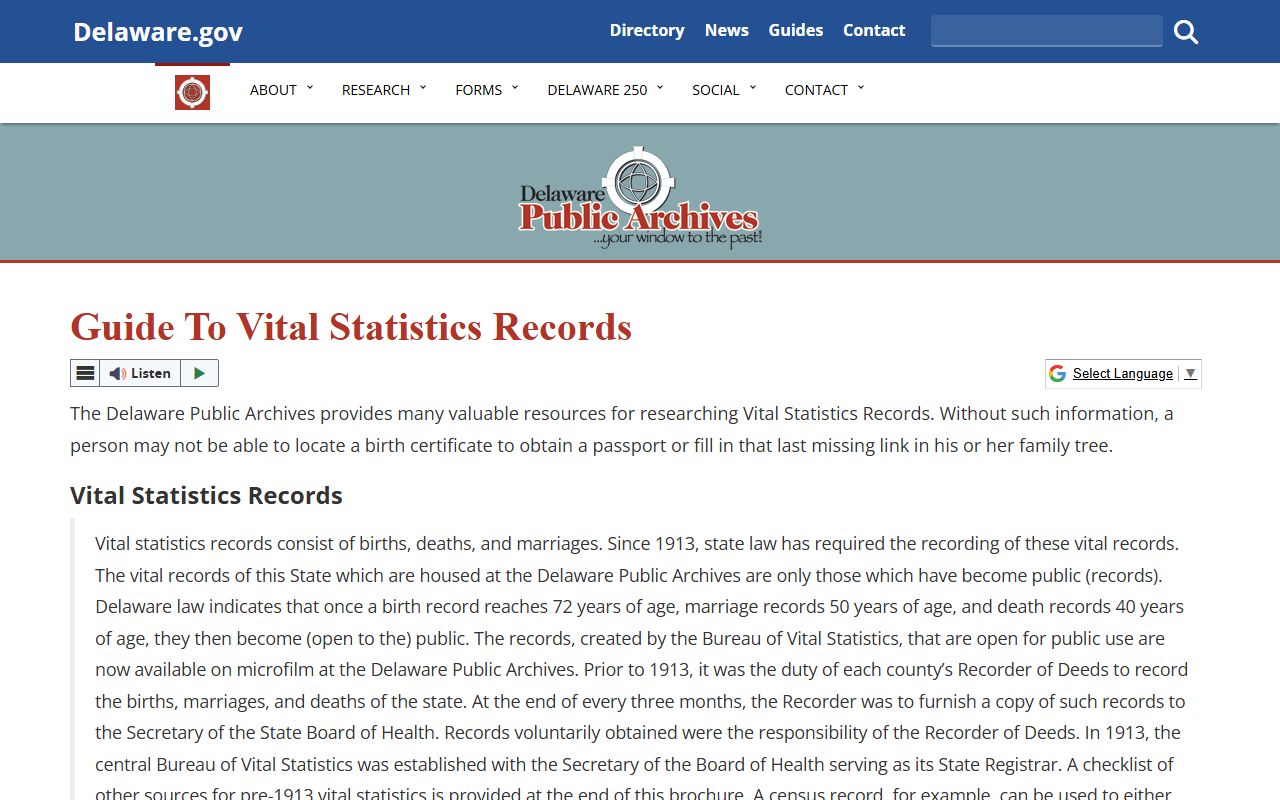
The guide is a good start, but it is not the full story. The Archives also keep a set of papers from the Historical Society of Delaware that reach back to the 1700s. These include family Bibles, church logs, and grave lists. They are not part of the formal death index, but they serve the same need when the formal rolls run out.
For a look at the law itself, Title 16 Chapter 31 of the Delaware Code is the core statute. See the full text at delcode.delaware.gov. A thumb through shows how the state defined a "death record" over the years.
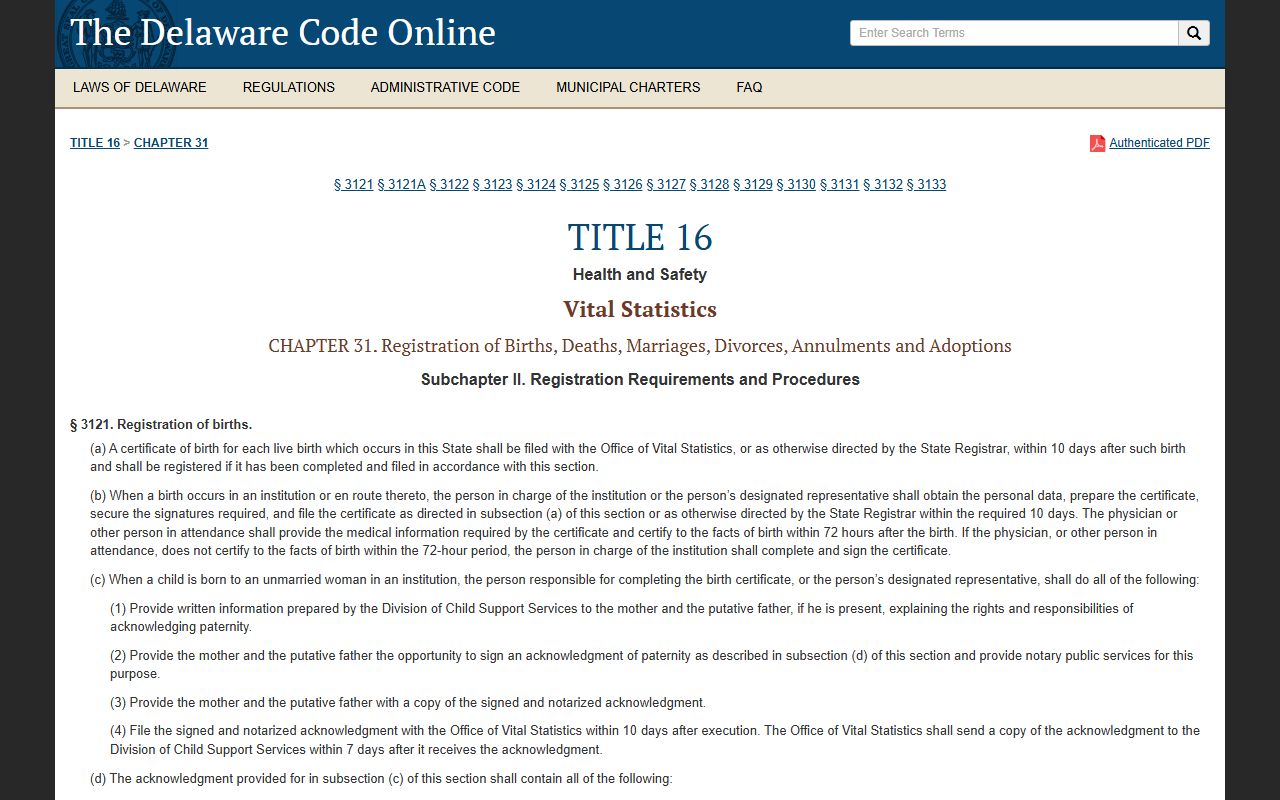
The main statute page lays out who must file, by when, and what must be on the form. It also sets the fee and lists who can view a record. If you plan to fight a rejection of your records request, print this page and bring it with you.
Family tree workers often skip the Archives and go to FamilySearch. The site at familysearch.org has free scans of many Delaware death rolls. This is a fast way to check before you drive to Dover.
Cemetery and Private Records
New Castle County has a long list of cemeteries. Each one keeps its own log of burials. These logs are not part of the state death index. But they can fill in gaps, mainly for the years before 1930. Cathedral Cemetery in Wilmington is one of the largest. It serves the Catholic community and dates back to the 1800s. The Schoenberg Memorial Chapel holds the main Jewish cemetery records for the area.
Small church graveyards dot the county. Some date to the 1600s. The Historical Society of Delaware in Wilmington keeps a shelf of bound burial lists. You can visit the reading room by appointment. The society's papers include ships' logs, Swedish church books, and farm ledgers. None of these are "official" in the eyes of the state. But a death note in a family Bible from 1790 may be the only proof you find.
Note: Always check two or three sources when a record is from before 1913, since spelling of names and even dates can shift from one log to the next.
The Recorder of Deeds office at the Louis L. Redding Building holds deeds for cemetery plots. You can see who owns a family plot going back decades. The Archives list the agency history at archives.delaware.gov. If you need to prove you have the right to add a new stone to an old plot, start with the deed.
Cities Served by the New Castle Death Index
All deaths in New Castle County feed into the same state death index. The Newark field office handles walk-ins no matter which city the person lived in. Click a city below for local help.
Other towns in the county include Bear, Claymont, Hockessin, Glasgow, Greenville, Elsmere, and Smyrna. All death records for these towns are filed with the same state office. The walk-in counter at 258 Chapman Road in Newark serves every resident of the county.
Nearby Counties
Delaware has only three counties. If the person died just south of the Chesapeake and Delaware Canal, the record may sit in Kent. If they died on a Rehoboth Beach trip, check Sussex. The state index covers all three, but local help desks differ.