
Search Delaware Death Index Records
The Delaware Death Index is the main file of deaths kept by the state. The Office of Vital Statistics holds these records and issues certified copies on request. You can search the Delaware Death Index by mail, online, or in person at one of three state offices. Recent deaths from 1972 to the present sit with the Office of Vital Statistics in Dover. Older death records are held by the Delaware Public Archives. To pull a record, you need the full name of the person and an approximate date or year. Start your Delaware Death Index lookup with the search tool below.
Delaware Death Index at a Glance
Delaware Death Index Overview
Delaware keeps a central Death Index at the state level. The Office of Vital Statistics holds death records from 1972 to the present. The office sits inside the Division of Public Health, which is part of the Department of Health and Social Services. Death records newer than 40 years are closed to the public. They are released only to the next of kin, an attorney, a funeral director, or a legal rep with proof. Once a death is more than 40 years old, it becomes a public record under state law.
The Office of Vital Statistics is the main source for recent Delaware Death Index data, and its public-facing page lists forms, fees, and order options for each type of certificate. 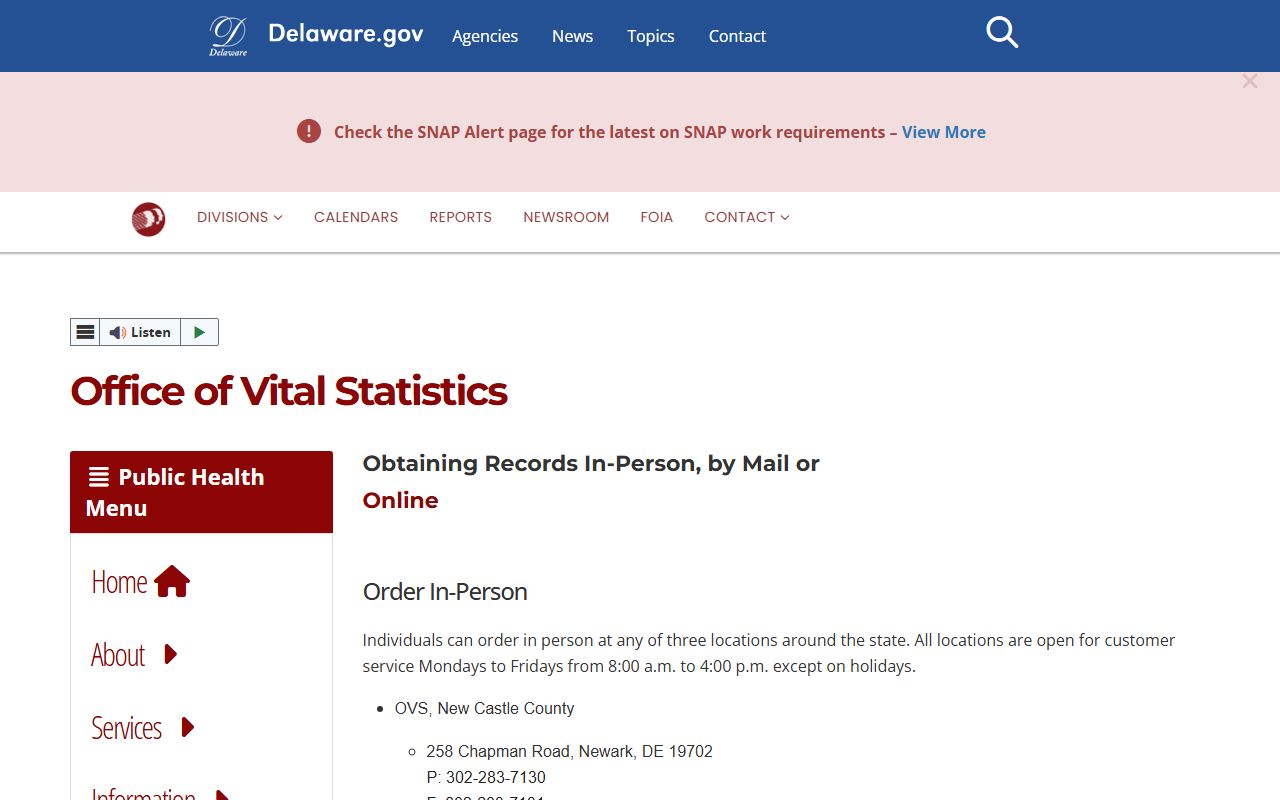 The page links to applications for birth, death, and marriage certificates and explains who may request each type of record. Scan the site first to make sure you have the right form and proper ID before you mail, call, or drop in.
Historical deaths get handled by a different office. The Delaware Public Archives holds all death records once they hit the 40-year mark. State law sets that window. Births become public after 72 years, marriages after 50, and deaths after 40. Researchers can also use the Archives for early-year deaths going back to the 1800s, long before state registration was required.
How to Search the Delaware Death Index
You have three ways to search the Delaware Death Index. You can order online, mail in a form, or walk into one of the state's three in-person offices. Each path has its own wait time. Online orders ship in two to five days. Mail orders take four to seven weeks. In-person requests are often done while you wait.
The Department of Health and Social Services runs the program through its Division of Public Health. The DHSS page lists forms, fees, and office addresses for all three counties, and it links out to the two state-approved online vendors. 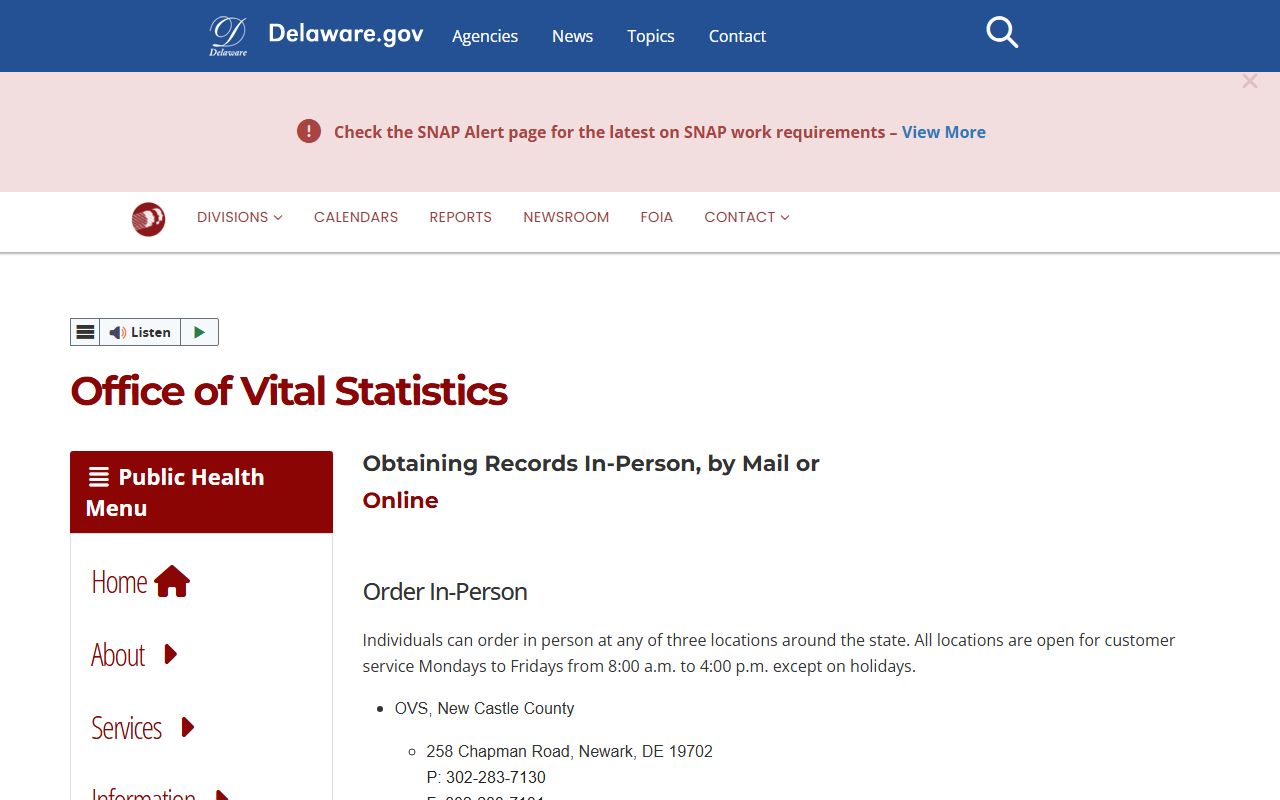 This is the best place to start if you are new to the process. The page has links to the death certificate form, the funeral director form, and the legal rep letter template used by attorneys.
For federal-style guidance, the CDC keeps a short sheet on where to send Delaware requests. The CDC Where to Write for Vital Records page gives the Dover address, the fee, and the phone number in a plain format. 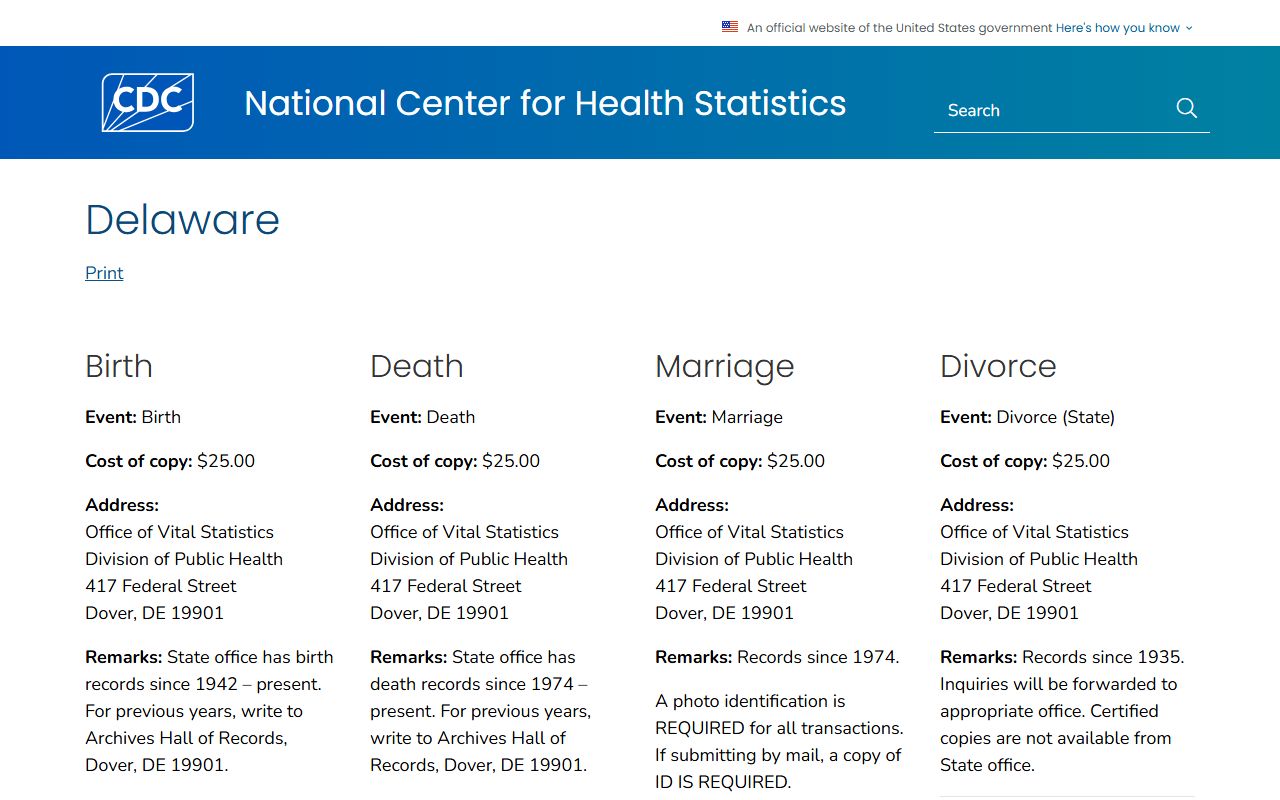 The sheet notes that the state office has death records from 1974 to the present and sends you to the Archives in Dover for anything older. It also states that a photo ID is required for all transactions.
To run a search, you need:
- Full name of the deceased
- Date or year of death
- Place of death if known
- Your photo ID and proof of relation
Where to Find Delaware Death Records
Three offices make up the public-facing side of the state Death Index. OVS Kent County is the central office in Dover at 417 Federal Street. Call (302) 744-4549 for fees or help. OVS New Castle County is at 258 Chapman Road in Newark at (302) 283-7130. OVS Sussex County is at 546 S. Bedford Street in Georgetown at (302) 515-3190. All three are open Monday to Friday, 8:00 a.m. to 4:00 p.m., except on state holidays.
Want a central guide to state records? The Delaware Certificates Guide page sets out which office holds what by year and event type.  The page explains that death certificates from 1986 to the present are with the Office of Vital Statistics while deaths from 1985 and prior are at the Delaware Public Archives. It also has a link to request apostilles for records used abroad.
Anyone can also use 211 for basic help. Delaware's Division of Public Health Vital Statistics Kent/Sussex page lists the same phone numbers but adds a short FAQ on what records are released, to whom, and when. 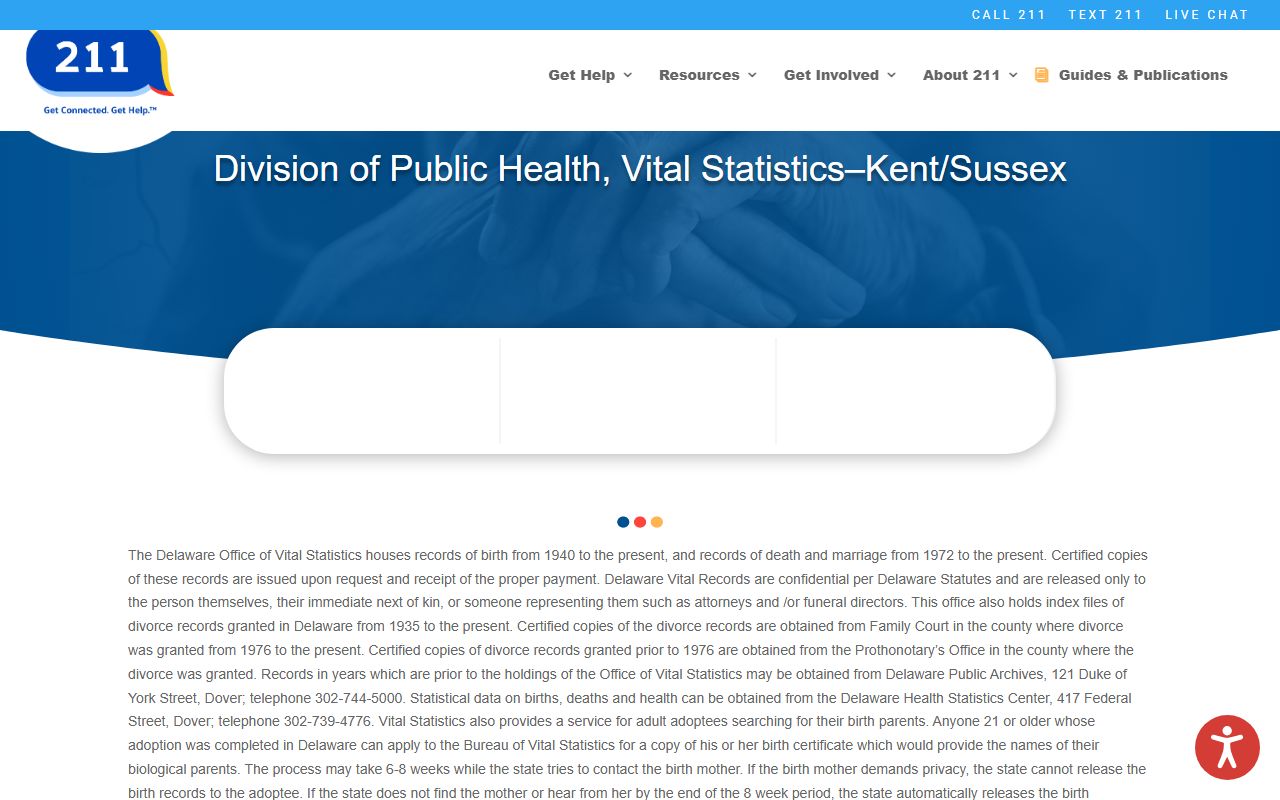 It confirms that the state also keeps a divorce index from 1935 to the present, though for certified divorce copies you still need to reach Family Court in the county where the case was granted.
Note: Bring a photo ID to any in-person visit and mail a copy of your ID with any mail request, since staff must check eligibility under 16 Del. C. § 3110.
What Delaware Death Records Show
A Delaware death certificate lists key facts about the person and the death. Typical fields include the full name of the decedent, date of death, place of death (city and county), date of birth, place of birth, place of burial, names of parents with the mother's maiden name, the spouse's name, occupation, and marital status. For older records, the form may also name the attending physician and list the cause of death along with a contributing cause.
Under 16 Del. C. § 3123, every death that occurs in Delaware must be filed with the Office of Vital Statistics within three days. The funeral director files the paper, and the attending physician or medical examiner signs off on the cause. The text of the law sits on the official state code site, which is the best place to read the current rule in full. 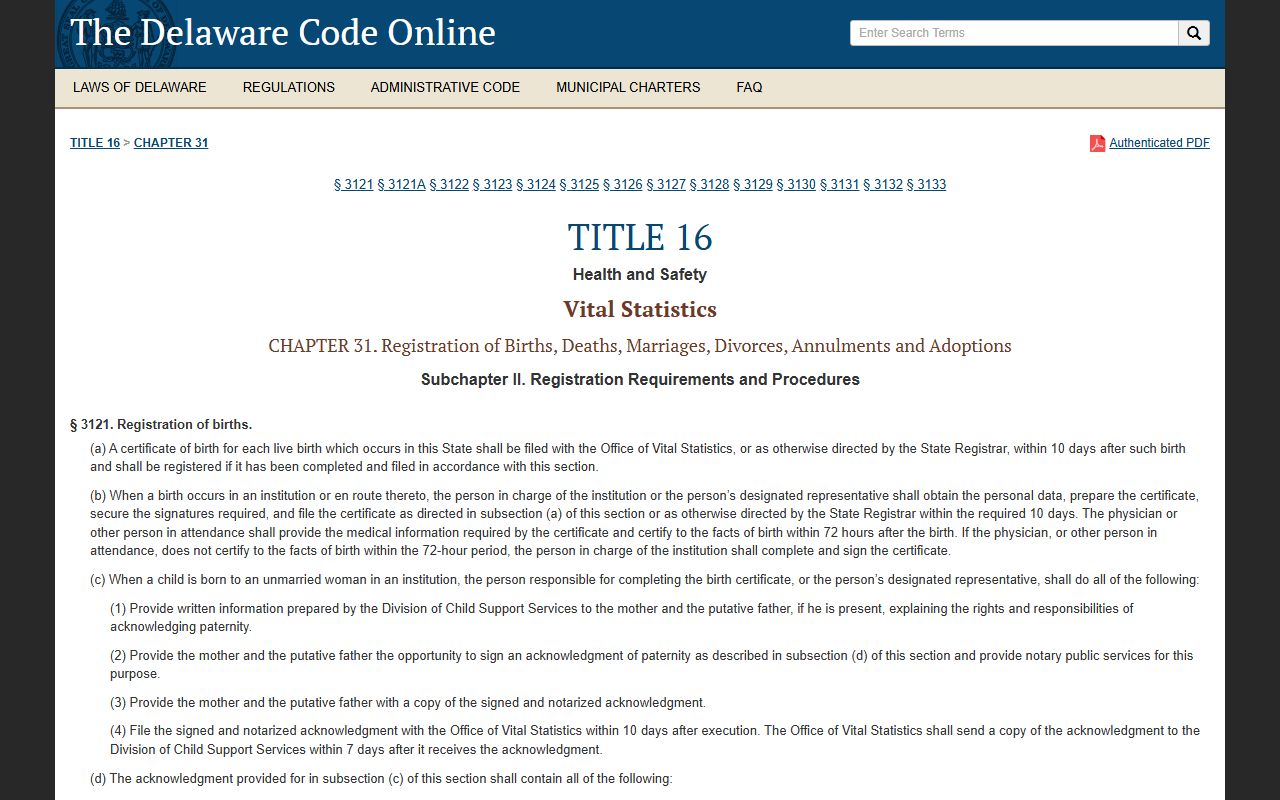 Title 16 Chapter 31 also sets the rules for late filing, for deaths on moving conveyances, and for pending certificates when the cause is not known in time.
Online Death Index Ordering
Delaware lets you order certified death certificates online through two approved vendors. GoCertificates and VitalChek both work with the state and ship in two to five days. Credit and debit cards are accepted. Each vendor adds its own processing fee on top of the state price.
You can also request letters for international use through the state. Delaware.gov explains that apostilles are prepared by the Secretary of State, Division of Corporations. If you need a sealed cert for probate in another state or for an overseas court, the state will attach the proper cover page. Mail orders should be sent to the Dover office at 417 Federal Street with a personal check or money order made out to the Office of Vital Statistics.
Privacy is a hard line in Delaware. The Open Government Guide for Delaware, hosted by the Reporters Committee for Freedom of the Press, breaks down the public-records law in detail.  It states that death certificates become public under 16 Del. C. § 3110(f) only after 40 years have passed since the date of death. Until then, the file is closed to third parties, and every request gets checked for proof of a qualifying relationship.
Historical Delaware Death Index Records
Historical death records move to the Delaware Public Archives once they pass the 40-year mark. The Archives sit at 121 Martin Luther King Jr. Blvd. North in Dover. Staff do minimal searching but let on-site researchers pull microfilm and scan the indexes. The building keeps death certificates from 1913 to the present, with the open years running from 1913 up to about 1985 at this time.
Before 1913, deaths were not filed with the state. Each county's Recorder of Deeds recorded births, marriages, and deaths, and forwarded a copy to the State Board of Health every three months. Records from that earlier period live in many places: the Archives, church ledgers, family Bibles, cemetery books, and probate files. The Archives guide lists it all. 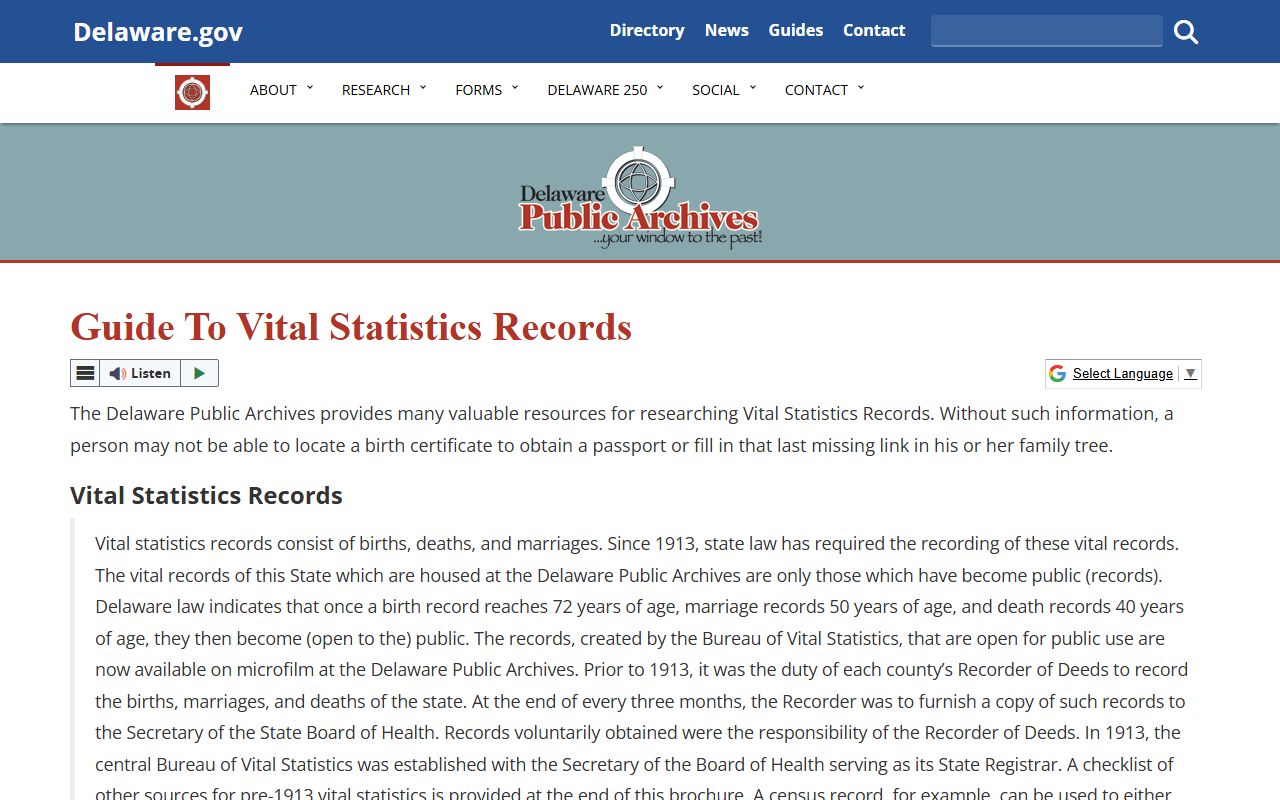 The guide to vital statistics records also sets the cost for copies: $10 for up to ten pages, $0.50 per page for microfilm prints, and $25 per certified copy for a legal use.
A digital version of the same guide works better for off-site research. The digital archives guide lists the same rules but has direct links to scanned indexes you can search from home.  The online tools work best if you already know a name and a rough year. Try variant spellings. Early clerks often wrote names by sound rather than by a fixed spelling.
Two more free sites help with old deaths. RAOgk Delaware Vital Records lists contact info and shares tips from volunteers for the three offices in Dover, Newark, and Georgetown.  And The Ancestor Hunt keeps a running list of free online probate and death collections for each county.
  These are good starting points for family research when the state office does not hold the record.
Probate and Estate Records in Delaware
Probate files back up a death record. When a person dies, the Register of Wills in the county where the person lived opens a file. That file tracks the estate: the will, an inventory of assets, claims, and final distribution. Probate records often contain death data that the certificate alone does not, such as the names of children, the spouse, and a list of heirs.
The Archives hold early probate material for all three counties. The Delaware Public Archives estate records page walks researchers through the main record types: wills, inventories, Orphans' Court files, guardian accounts, and Chancery Court files.  Each Register of Wills office charges $2.00 to send a letter stating what is on file for a given name. For the full file, you either travel to Dover or order copies by the page.
Under Delaware law, an estate must be probated if the person owned more than $30,000 in personal property alone or held real property in their name alone. The rule sits in Delaware Code Title 12, Chapter 25. Without proper probate, heirs cannot clear title to a home, which can block loans, insurance, and even utility help. Each Register of Wills office keeps a list of attorneys who handle probate for residents who need help.
Heads up: Keep the original death certificate in a safe place. You will need it for probate, for bank claims, for Social Security, and for transfer of real estate or vehicles.
Delaware Death Index Access Rules
Vital records in Delaware are closed until they age into the public domain. Under 16 Del. C. § 3110, death files stay private for 40 years. During that window, only the person listed (for birth files), the next of kin, a legal rep, or a funeral director may get a copy. After 40 years, the file opens to any researcher.
The Freedom of Information Act in Delaware, found in 29 Del. C. § 10002, governs most other public records. Each state agency names a FOIA coordinator. Requests may be made in writing, by email, by fax, or online. The agency has 15 business days to respond. State tax data is carved out and is not subject to FOIA under 30 Del. C. § 368.
Legal reps face extra steps. A letter must be on firm letterhead, state the purpose, name the client's tie to the person listed on the record, and cite the law that makes the request valid. The Office of Vital Statistics keeps a template on file. Miss any of these items and the office will reject the request. Funeral directors use a separate form under 16 Del. C. § 3123 that is tied to their role in filing the certificate itself.
Browse Death Index by County
Delaware has three counties. Each county handles local records like probate and deeds through its own offices, but the Death Index itself stays at the state level. Pick a county below to see local contact info, office hours, and resources.
Death Index in Major Delaware Cities
Cities do not keep their own Death Index. Residents in Delaware cities all order from the same state office. Pick a city below to find the nearest in-person office and local resources.